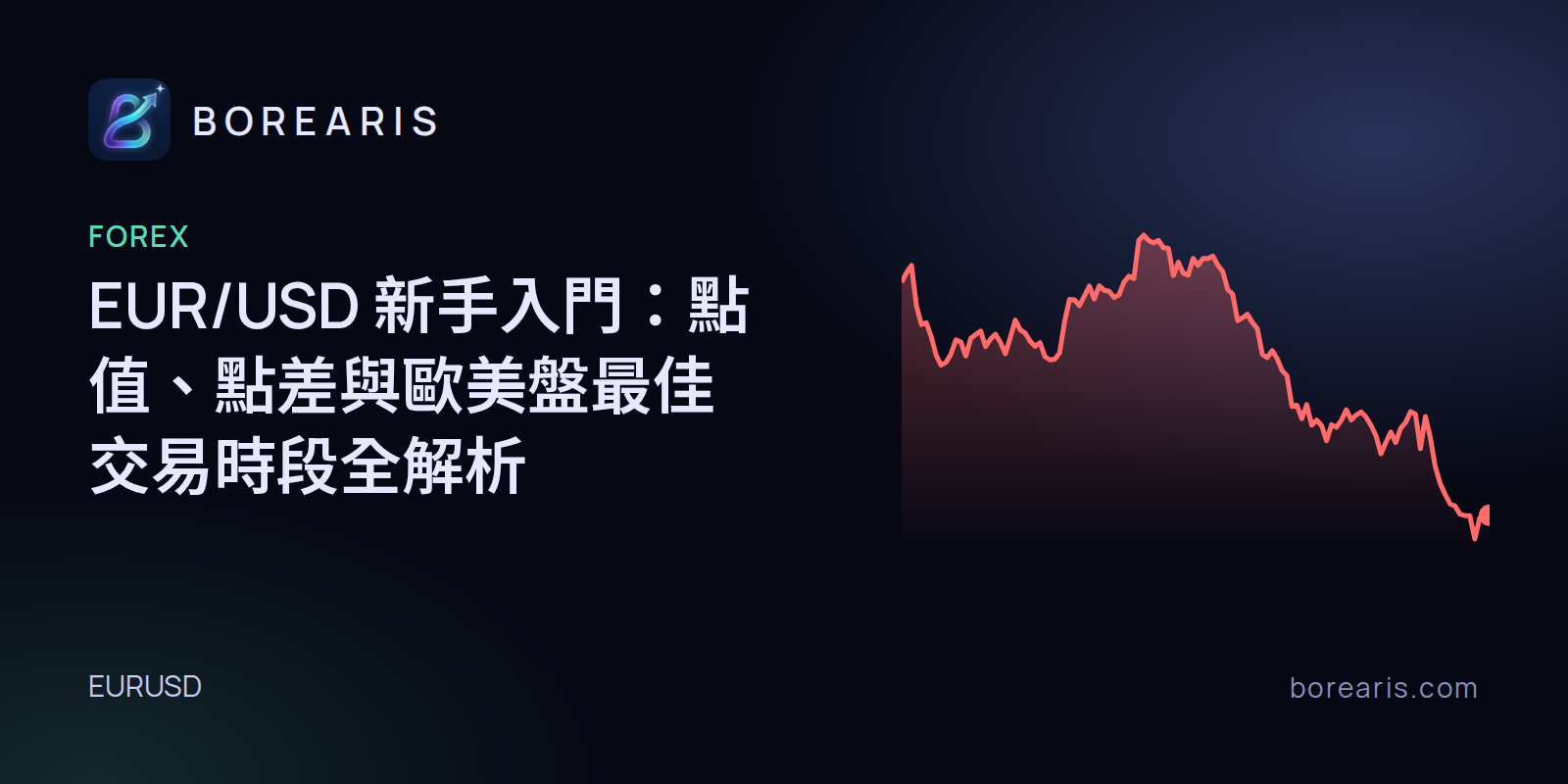
EUR/USD for Beginners: Pip Value, Spread and the Best Trading Hours
Learn how pip value and spread work on EUR/USD before you trade. This guide shows how contract size drives profit and loss, why spread is a hidden cost, and how the European and US session overlap shapes volatility.
Why pip value and spread come first
EUR/USD (EURUSD) is the most heavily traded currency pair in global markets. Quotes are easy to read and liquidity is deep, which makes it a common first stop for new traders. The most frequent beginner mistake, however, is focusing only on direction while ignoring two things: how much each pip is worth, and how much spread is taken out the moment you enter. If those numbers are unclear, even a correct call can be eroded by costs.
A pip is the standard unit of price movement for EUR/USD, quoted to the fourth decimal place, so one pip equals 0.0001. Pip value is how much your position gains or loses when price moves one pip, and it depends on contract size. Spread is the gap between the bid and the ask, which is the cost you carry right after entering.
Calculating pip value from contract size
The logic is straightforward: contract size multiplied by the price change of one pip. With a standard contract of 100,000 units, a 0.0001 move in EUR/USD corresponds to 10 in the quote currency, the US dollar. Smaller contracts scale down: 10,000 units gives roughly 1 per pip, and 1,000 units gives roughly 0.1. Many platforms display pip value directly, but knowing the math keeps your sizing disciplined.
Consider a scenario. Suppose you establish a position near the current EUR/USD price of 1.09721, and price later moves toward the nearest resistance above at 1.12107. With a standard contract of 100,000 units, the distance in pips multiplied by 10 per pip gives the gross profit and loss scale, before spread and any overnight financing. On the other side, if price falls toward the nearest support below at 1.08121, the same approach lets you estimate the downside before choosing position size.
Spread is a hidden cost, especially for short-term trading
Spread is usually quoted in pips, and a smaller number means lower trading cost. Because EUR/USD is the most liquid pair, its spread tends to be narrow compared with other majors, but narrow does not mean negligible. Traders who enter and exit repeatedly pay the spread each time, and it adds up. Longer-term holders feel it less, but it still shows up in the entry price.
A simple check for beginners: compare your expected target in pips with the spread. If a trade aims for only a few pips while the spread takes a large share of that, the risk-reward structure is already poor. Rather than chasing frequency, calculate what proportion of expected profit goes to cost. To track events that move the euro and the dollar, use the economic calendar and avoid the periods around major releases when spreads often widen.
The European and US session overlap
EUR/USD spans both the European and US trading sessions. The overlap, when both regions are active, usually brings higher liquidity and volatility, and spreads tend to be more stable. During Asian hours, EUR/USD volatility is often more contained, and breakout strategies can run into false moves.
Session timing is context, not a signal. Looking at the current data, EUR/USD trades at 1.09721, below its 20-day moving average of 1.10618 and its 50-day moving average of 1.11761, with RSI14 at 35.3, which points to recent weakness. Meanwhile, the US Dollar Index (DXY) trades at 103.859, above its 20-day moving average of 102.720 and its 50-day moving average of 101.929, with RSI14 at 66.0. If dollar strength persists, EUR/USD may keep consolidating below its moving averages; if dollar momentum fades, a rebound toward those averages is possible. These are scenarios, not guarantees.
Risk awareness and tools
Three practical steps for beginners. First, start with smaller contract sizes to get comfortable with pip value and spread rather than using full size immediately. Second, calculate your stop level together with pip value so you know the worst-case loss before entering. Third, avoid the sharp moves around major data releases, especially when spreads suddenly widen.
To follow EUR/USD price structure and moving averages, see the EUR/USD analysis page. To monitor dollar strength alongside it, check the US Dollar Index (DXY) analysis page. If you prefer a disciplined approach to swing opportunities, swing signals can serve as a supporting reference. Master pip value, spread and session timing before moving on to strategy, and you will build on firmer ground. Download the app to keep live quotes and analysis with you.
Borearis Research Team · For information only, not investment advice. Trading involves risk.