
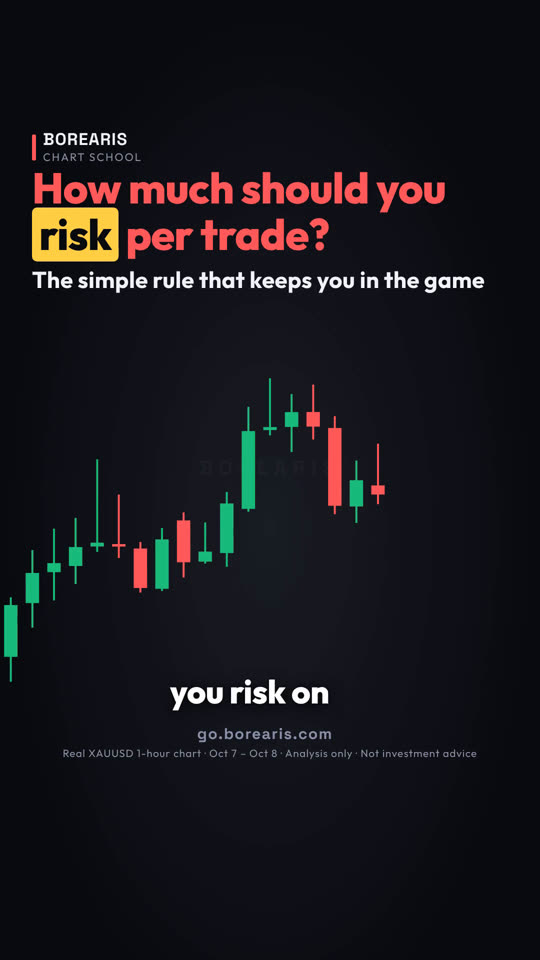
How much should you risk per trade? The fixed percent rule
How much do you risk on one trade? Be honest. If you don't know the exact number, this is for you.
- Pick one fixed percent per trade. Many traders use 1–2%.
- At 1%, ten losses in a row still leave about $9,040 of $10,000. At 10%, about $3,490.
- Size from the stop: lots = dollar risk ÷ (stop distance × value per $1 move).
- Gold, 1 standard lot: a $1 move = $100. A $10 stop on $100 risk = 0.1 lots.

The real chart used in this lesson
Real XAUUSD 1-hour chart · Oct 7 – Oct 8
Quiz at the end: How much do you risk per trade: 1%, 5%, or no idea?
Full transcript
How much do you risk on one trade? Be honest.
If you don't know the exact number, this is for you.
Pick one fixed percent of your account, and risk that on every trade.
Many traders use 1 to 2 percent. On 10,000 dollars, 1 percent is 100.
Why so small? Losing streaks happen.
At 1 percent, ten losses in a row still leave about 9,040 dollars.
Risk 10 percent each time, and the same ten losses leave about 3,490.
Next, turn 100 dollars into a lot size. Start from the stop, not a feeling.
On this gold chart: buy at 4120, stop at 4110, just under the last low.
Gold, 1 standard lot: price moves 1 dollar, that's 100 dollars.
So a 10 dollar stop costs 1,000 per lot. 100 divided by 1,000 is 0.1 lots.
This one hit the stop. You lost 100 dollars, 1 percent. Exactly the plan.
Wider stop, smaller size. Tighter stop, bigger size. Same dollar risk.
Save this. One fixed percent per trade, 1 to 2 is common. Size from the stop.
Your turn. How much do you risk per trade? 1 percent, 5 percent, or no idea? Comment below.
Follow for one chart lesson every day.
go dot borearis dot com.
Keep watching




AI-voiced; written and reviewed by the Borearis Research Team. For education only, not investment advice. Trading involves risk.