
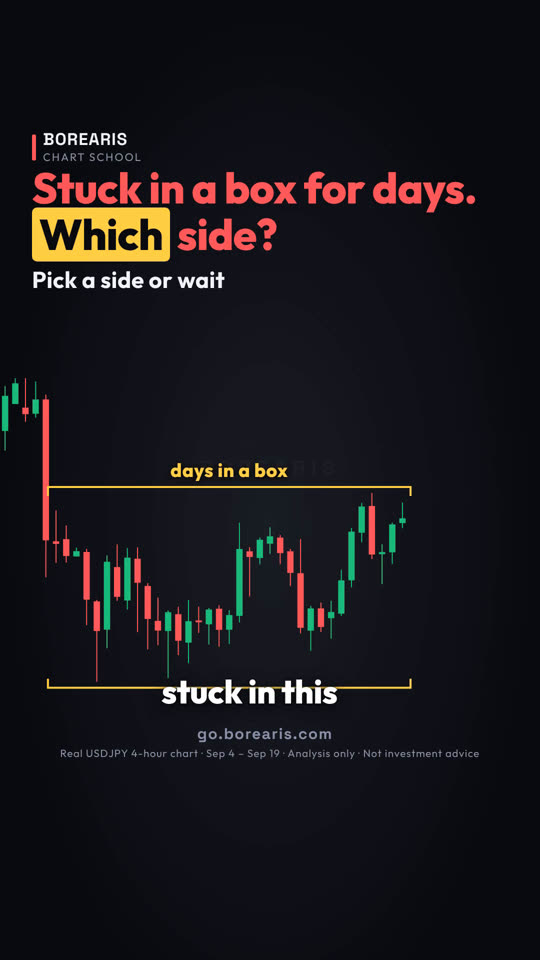
卡在箱子好幾天,做哪邊?
價格卡在這個箱子好幾天了。你會買底部、賣頂部,還是等突破?
- 標出區間:一條線畫在最高高點,一條畫在最低低點。
- 做邊緣,不做中間。止損放在區間外一點點。
- 影線戳出去不算突破。收盤在外才算。
- 收盤在外 = 區間結束了。不要再逆勢做。


這堂課用的真實 K 線
Real USDJPY 4-hour chart · Sep 4 – Sep 19
影片最後的小測驗:下次看到區間:買底部、賣頂部,還是等突破?
影片完整旁白(英文原文)
Price has been stuck in this box for days.
Would you buy the bottom, sell the top, or wait for the break?
Step one: mark the box. One line on the highest high, one on the lowest low.
Here, the top sits near 155, and the bottom near 152.9.
Step two: trade the edges, not the middle.
Near the bottom, you can buy, with a stop just below the box.
Near the top, you can sell, with a stop just above the box.
In the middle, there's no edge. Just noise. Stay out.
Step three: a close outside the box ends it.
A wick poking out is not enough. You need a candle that closes outside.
So what happened here? On September 15, one candle poked above the top, but closed back inside.
Two candles later, one closed above. Box over. Dollar yen then climbed to about 158.
If you sold the top, your stop above the box kept the loss small.
If you waited, that close outside was your signal to stop selling.
Save this. Mark the box. Trade the edges, stop outside. Middle, stay out. Close outside, the box is over.
Your turn. Next box you see: buy the bottom, sell the top, or wait for the break? Comment below.
Follow for one chart lesson every day.
go dot borearis dot com.
接著看



影片為 AI 配音,內容由 Borearis 研究團隊撰寫審核。僅供學習參考,不構成投資建議,交易有風險。